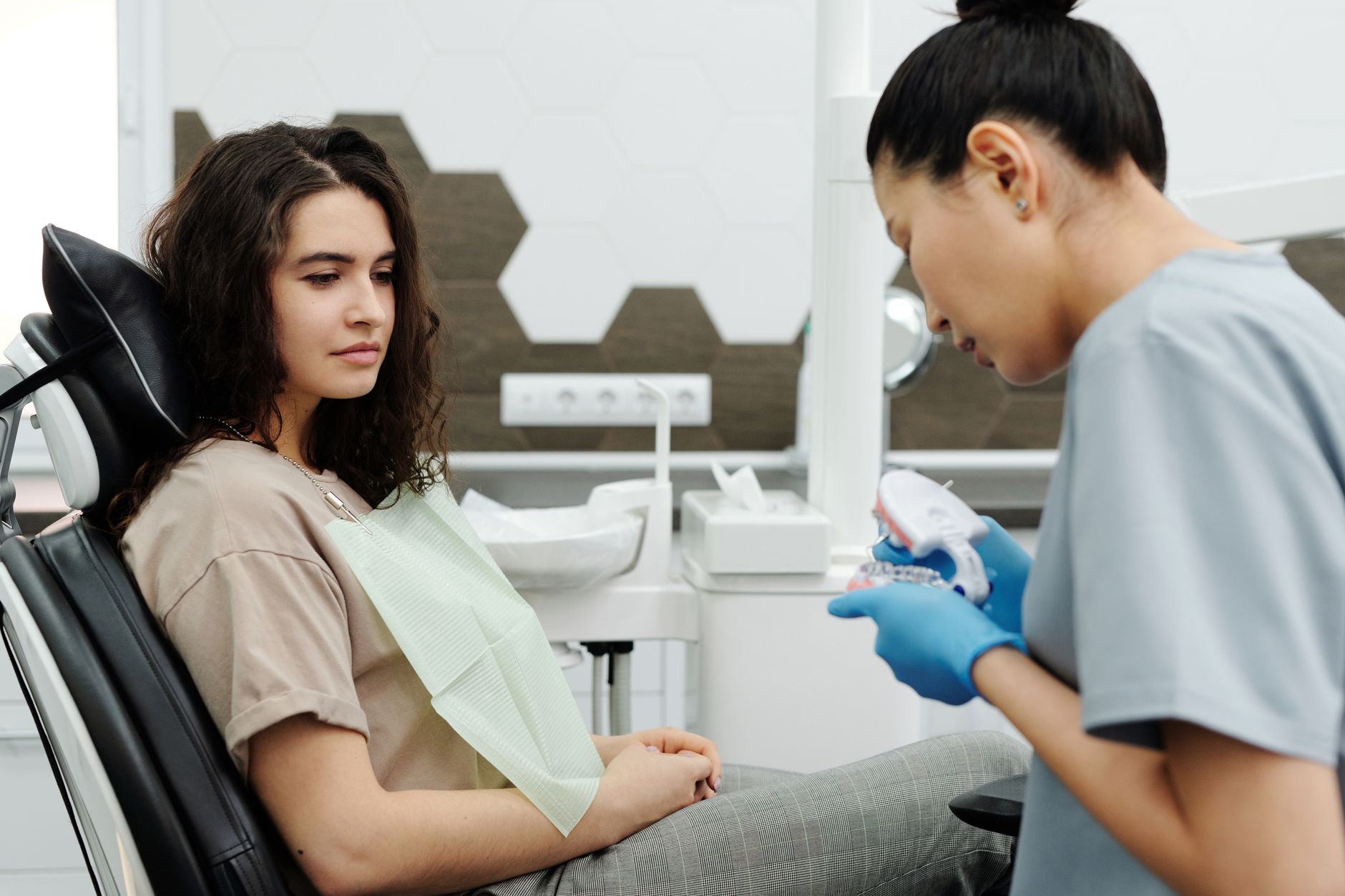
Phase 1 orthodontic treatment starts between ages 6 and 10. The American Association of Orthodontists recommends a first evaluation by age 7. It uses expanders, partial braces, or functional appliances to correct jaw growth, crossbites, and severe crowding while a child's bones are still developing and highly responsive to treatment.
What Is Phase 1 Orthodontic Treatment?
Phase 1 orthodontic treatment is early interceptive care performed while a child still has a mix of baby and permanent teeth, typically between ages 6 and 9, with the AAO recommending a first orthodontic evaluation by age 7 (olsenortho.com). The goal is not to achieve a perfectly finished smile. Instead, it corrects underlying skeletal and jaw development problems. This happens before they worsen, compound, or require surgical intervention later. At One Smile Orthodontics, we emphasize this foundational approach because early intervention during active growth can prevent the need for surgical correction later in life. Early action prevents surgery. Think of Phase 1 as laying the structural foundation for a house before adding the interior finishes. Common appliances include palatal expanders, space maintainers, partial braces, and functional jaw appliances such as Herbst or Twin Block devices. This reality is something every honest orthodontist should tell parents upfront.
How Is Phase 1 Different from Phase 2?
The distinction matters and is frequently misunderstood. Phase 1 targets jaw and skeletal development during childhood growth. Phase 2 focuses on tooth alignment and bite refinement using full braces or Invisalign for teens after most or all permanent teeth have erupted, generally around ages 11 to 14. Phase 1 treatment typically lasts 9 to 12 months. A resting period of observation follows. Then Phase 2 begins. A child who completes Phase 1 will almost certainly still need Phase 2, but treatment is typically shorter and less complex than if early intervention had been skipped entirely. Phase 1 simplifies Phase 2. Phase 2 comprehensive treatment for teens and adults typically lasts 12 to 30 months; when Phase 1 has been skipped, treatment may run toward the longer end of that range — sometimes up to 30–36 months — depending on case complexity (centraloregonortho.com).
| Phase | Age Range | Primary Goal | Typical Duration | Common Appliances |
|---|---|---|---|---|
| Phase 1 | Ages 6-10 | Jaw and skeletal correction | 12 to 18 months | Palatal expander, Herbst, space maintainer |
| Resting Period | Ages 9-12 | Monitoring eruption of permanent teeth | 6 to 18 months | Retainer (if prescribed) |
| Phase 2 | Ages 11-14 | Tooth alignment and bite refinement | 18 to 24 months | Full braces or Invisalign for teens |
When Should a Child Start Phase 1 Treatment?
The American Association of Orthodontists recommends a comprehensive orthodontic evaluation by age 7, when the first permanent molars and incisors have typically erupted (olsenortho.com). At this stage, an orthodontist can detect crossbites, underbites, severe crowding, and jaw asymmetries while growth is still active and correction is highly efficient. Early evaluation does not always mean early treatment. Many children are placed on a monitoring schedule. Check-ins occur every 6 to 12 months. Active treatment begins only when the developmental window is optimal. This watchful waiting approach is the norm, not the exception. Starting treatment at the right moment, rather than the earliest possible moment, can prevent the need for tooth extractions or jaw surgery later. Timing is everything.
What Warning Signs Tell Parents to Act Now?
Some symptoms genuinely warrant prompt evaluation before age 7. Persistent mouth breathing or snoring can signal airway narrowing that palatal expansion may help correct. A crossbite, where upper teeth bite inside lower teeth, worsens progressively with growth and is most efficiently addressed with a palatal expander during Phase 1. Early or late loss of baby teeth, thumb sucking past age 5, tongue thrusting, and teeth that appear severely crowded or widely spaced are all signs worth evaluating without delay. Children who visibly shift their jaw sideways when biting together, or who frequently bite their cheek or tongue, may have skeletal discrepancies that respond best to early treatment. Don't wait for symptoms to worsen. Acting during active growth is the entire clinical advantage of Phase 1.
What Does Phase 1 Treatment Involve?
Phase 1 treatment is customized to each child's developmental needs. It typically involves one or more orthodontic appliances. Active treatment lasts 9 to 12 months. Some complex cases extend to 12 to 18 months. The most important thing parents can understand is that Phase 1 is not a simplified version of braces. It is a fundamentally different type of intervention that works on bones and jaw structures, not just tooth positions. Treatment may involve a palatal expander to widen the upper jaw, functional appliances to guide lower jaw growth, space maintainers to preserve eruption pathways, partial braces to align severely rotated incisors, or habit appliances to address thumb sucking and tongue thrusting. A resting and observation period follows active Phase 1 treatment, during which the child is monitored closely before Phase 2 begins.
What Is a Palatal Expander and How Does It Work?
A palatal expander is the most common Phase 1 appliance. It is a fixed or removable device bonded to the upper back teeth that applies gentle lateral pressure to slowly widen the upper jaw. It works by gradually separating the two halves of the midpalatal suture, which remains unfused and highly responsive in children, allowing new bone to fill the gap between the two halves. Parents typically activate the expander at home using a small key to turn a central screw following the orthodontist's prescribed schedule, usually once per day. Expansion is followed by a consolidation period of several months during which the expander remains in place while new bone solidifies. Results include a wider upper arch, corrected posterior crossbite treatment, improved nasal airway width, and adequate space for erupting permanent teeth. The process sounds more intimidating than it feels. Most children adapt within one to two weeks.
How Does Phase 1 Address Airway and Breathing Problems?
A narrow upper jaw can restrict nasal airway volume, causing children to breathe through the mouth chronically. For example, consider a 7-year-old in West Covina who snores at night and struggles to focus in school; his parents notice he breathes through his mouth constantly. A palatal expander could widen his upper jaw, open his nasal airway, and help him transition to healthy nasal breathing, potentially improving his sleep quality and classroom attention within months. This is exactly the type of case where early Phase 1 intervention delivers life-changing results that go far beyond straightening teeth. This pattern negatively affects facial development, sleep quality, and even cognitive function over time. Palatal expansion physically widens the floor of the nasal cavity, increasing airway space and helping children transition from mouth breathing to nasal breathing. Better breathing follows expansion. Airway orthodontics, a growing area of the field, considers the relationship between jaw structure and whole-body health. Children treated early for airway-related orthodontic problems may experience improvements in sleep quality, behavior, attention span, and school performance. Collaboration between the orthodontist, pediatrician, and ENT specialist is recommended whenever a child shows signs of sleep-disordered breathing or pediatric sleep apnea. Mouth breathing children deserve more than a wait-and-see approach.
Habit Appliances for Thumb Sucking and Tongue Thrusting
Not all Phase 1 intervention involves expanders or functional devices. Habit appliances are a distinct category of Phase 1 tools designed specifically to correct thumb sucking, finger sucking, and tongue thrusting that persist past age 4 or 5. These habits exert constant pressure on developing teeth and jaws, pushing front teeth forward and creating open bites or flared incisors that worsen over time. Fixed habit appliances, which attach to the back teeth and include a small barrier in the roof of the mouth, make thumb or finger sucking uncomfortable without being painful, effectively disrupting the habit within weeks. Tongue cribs address tongue thrusting by blocking the tongue from pressing against the front teeth during swallowing. Addressing these habits during childhood growth is far more effective than attempting correction after the jaw has finished developing. Left untreated, a significant overjet from prolonged thumb sucking also increases the risk of traumatic dental injury during childhood.
What Are the Benefits and Limitations of Phase 1 Treatment?
The primary clinical benefit of Phase 1 treatment is straightforward: it leverages a child's active growth to correct skeletal problems that become difficult or impossible to address with orthodontics alone once growth is complete. A crossbite corrected at age 8 with an expander takes months. Growth makes it easy. The same crossbite left until adulthood may require surgical jaw correction. Early treatment can reduce or eliminate the need for tooth extractions. According to peer-reviewed orthodontic literature, a substantial proportion of orthodontic patients nationally require tooth extraction before or during treatment, and proactive space management during Phase 1 is one of the most reliable ways to avoid that outcome. Phase 1 also reduces self-esteem damage caused by protruding front teeth while simultaneously lowering the risk of traumatic dental injury to those teeth.
Limitations are equally real and worth naming honestly. Phase 1 rarely produces a finished smile. Phase 2 with children's braces or Invisalign is almost always still required afterward. Families are committing to two distinct treatment periods and two rounds of costs. The evidence base strongly supports Phase 1 for crossbites, significant skeletal discrepancies, and severe crowding. It does not strongly support Phase 1 for mild spacing or minor alignment issues that a single comprehensive phase could handle just as well at age 12. At One Smile Orthodontics, we take the position that recommending Phase 1 when it isn't genuinely indicated is a disservice to families. Dr. Kim reviews every case individually to determine whether early intervention will produce measurable clinical benefit or whether monitoring and a single phase is the smarter path.
Does Phase 1 Treatment Mean My Child Will Still Need Braces?
In most cases, yes. Phase 1 addresses foundational jaw and skeletal issues, but Phase 2 with full braces or Invisalign for teens is still needed to finalize tooth alignment and bite refinement. The key advantage of completing Phase 1 successfully is that Phase 2 tends to be shorter, less complex, and less likely to involve extractions. Some children with mild Phase 1 concerns may be candidates for a single comprehensive phase beginning around age 11 to 13. An in-person two-phase treatment evaluation is the only way to determine which path is truly appropriate for a given child.
How to Choose an Orthodontist for Phase 1 Treatment
Phase 1 cases demand a higher level of clinical expertise than standard adolescent braces. A board-certified orthodontist, recognized by the American Board of Orthodontics, has completed two to three years of specialized residency training beyond dental school and passed rigorous written and clinical examinations. Our team has found that this level of training is essential for Phase 1 cases, where precise cephalometric analysis and understanding of growth patterns directly influence treatment outcomes. Board certification matters here because early treatment requires precise growth analysis, cephalometric evaluation, and deep knowledge of appliance biomechanics. In the West Covina, CA area, families have access to a range of orthodontic practices, but the quality of case planning and doctor involvement varies considerably. A high-volume practice model where assistants manage most appointment interactions is a different clinical experience than a doctor-led practice where the orthodontist personally evaluates and adjusts every case. For growing children, where subtle timing errors in appliance activation can have lasting skeletal effects, doctor-led care is not optional. It is the standard of care.
What Questions Should Parents Ask at a Phase 1 Consultation?
Parents in West Covina and the broader San Gabriel Valley should arrive at an orthodontic consultation prepared with specific questions that reveal whether the practice is genuinely suited to early treatment. Ask whether the doctor personally evaluates and designs each treatment plan or whether case planning is delegated. Ask what specific problem Phase 1 would address and how the practice measures that it has been corrected by the end of treatment. Ask about appliance compliance expectations and what happens if a child struggles to cooperate. Ask about insurance acceptance, including PPO plans and whether the practice accepts Medi-Cal, because two-phase orthodontic treatment involves multiple cost events and financial transparency upfront prevents difficult surprises later.
Frequently Asked Questions
At what age should a child have their first orthodontic evaluation?
How long does Phase 1 orthodontic treatment typically last?
How much does Phase 1 orthodontic treatment cost, and does insurance cover it?
Can a child skip Phase 1 and just wait for braces later?
Does Phase 1 treatment hurt?
What is the difference between a palatal expander and braces?
Can Phase 1 orthodontics help with mouth breathing and sleep problems in children?
How soon after Phase 1 does Phase 2 begin?
Is Phase 1 orthodontic treatment covered by Medi-Cal?
What are the signs a child needs Phase 1 orthodontic treatment?
What appliances are used in Phase 1 orthodontics?
How much does early orthodontic treatment cost?
What's the difference between Phase 1 and Phase 2 braces?
Sources & References
- Applying AAO Guidelines For Personalized Orthodontic Care - Central Oregon Orthodontics (opens in a new tab)[industry]
- Why Early Orthodontic Treatment Matters - Olsen Orthodontics (opens in a new tab)[industry]
- 2026 Alert: Why the AAO Says Every 7-Year-Old Needs an Orthodontic Evaluation - SMILE-FX Orthodontic & Clear Aligner Studio (opens in a new tab)[industry]
- Braces Statistics: 2026 Verified Report - WifiTalents (opens in a new tab)[industry]
- Early Orthodontic Care at Age 7: A Path to Cost-Effective Treatment | American Association of Orthodontists (opens in a new tab)[factcheck]
- Phase 1 Orthodontics | Children's Hospital of Philadelphia (opens in a new tab)[factcheck]
- Habit Breaking Appliance for Multiple Corrections – PMC (NCBI) (opens in a new tab)[factcheck]
- Midpalatal Suture Maturation Method for the Assessment of Maturation before Maxillary Expansion: A Systematic Review - PMC (opens in a new tab)[factcheck]
- What Is Two-Phase Orthodontic Treatment? | American Association of Orthodontists (opens in a new tab)[factcheck]
- Very early orthodontic treatment: when, why and how? – PMC (peer-reviewed) (opens in a new tab)[factcheck]
About the Author
One Smile Orthodontics
One Smile Orthodontics is a West Covina practice led by Dr. Namgu Kim, offering board-certified expertise in braces, Invisalign, and airway orthodontics for all ages.
Learn more at www.onesmileorthodontics.com → (opens in a new tab)Related Posts

7 Foods You Cannot Eat With Braces (And What to Eat Instead)
Braces are a significant investment in your smile, and what you eat can make or break your progress. This guide covers the 7 most damaging foods to avoid during orthodontic treatment, explains exactly why they cause problems, and offers delicious safe alternatives so you never feel deprived.
14 min read
Lingual Braces vs. Invisalign: Which Is Better for Adults Who Want Hidden Treatment?
Both lingual braces and Invisalign offer nearly invisible orthodontic treatment for adults, but they work very differently and suit different cases. This comparison breaks down cost, comfort, effectiveness, and lifestyle fit so you can choose the right hidden treatment for your smile goals.
9 min read
How to Keep Teeth Clean With Braces: A Step-by-Step Brushing and Flossing Guide
Keeping teeth clean with braces requires more effort than regular brushing, but the right technique makes it manageable. This step-by-step guide covers brushing angles, flossing methods, and the tools that protect your smile while you straighten it.
13 min read